Screen every payment
before the money moves.
Hold or release each payment in milliseconds against sanctions, PEPs, adverse media, and your watchlists.
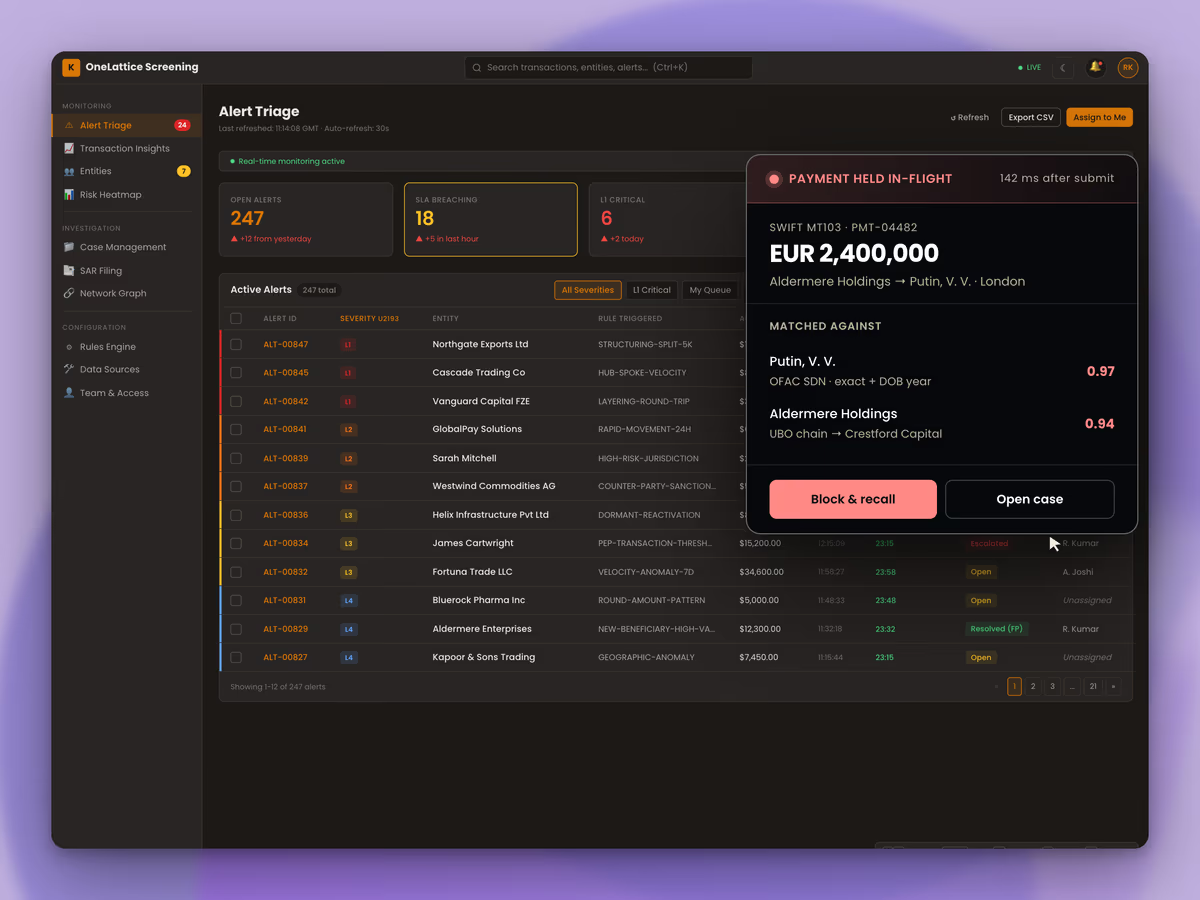
Screen against the lists that matter.
Sanctions, PEPs, adverse media, and your own internal lists run on the same pass. List updates land within minutes of publication.
Clear global sanctions
OFAC SDN and Consolidated, UN, EU, HMT, DFAT, and SECO clear on every payment, alongside 200+ domestic regimes across 240+ jurisdictions.
PEPs and RCAs
A four-tier PEP profile resolves on every counterparty, including relatives and close associates, with historical exposure retained for context.
Adverse media
Every alert tags adverse-media hits by financial-crime theme and attaches them to the matched counterparty, drawn from 100,000 sources in 80+ languages.
Run your own watchlists
Your own block, allow, and white lists deploy unlimited entries with role-based edit permissions and full change history on every entry.
Sanctioned ownership and SOEs
The ownership graph catches entities owned by sanctioned parties above a threshold you set, resolving indirect exposure on every payment.
Continuous refresh
Sanctions updates land within 15 minutes of publication. PEP profiles re-check daily. Internal-list edits go live the moment you save.
RAILS AND MESSAGE FORMATS
Parse every payment format your hub already speaks.
Field-level parsing across cross-border messaging, real-time rails, and batch settlement. Originator, beneficiary, intermediary, BIC, account, and free-text reference all clear on a single screening pass.
Cross-border messaging
- SWIFT MT103, MT202, MT202COV
- SWIFT MX and ISO 20022
- Correspondent and nostro flows
- Cover and serial payments
Real-time and instant rails
- FedNow, RTP, SEPA Instant, FPS
- UPI, IMPS, PIX, NPP
- PayNow, FAST, Zengin
- ISO 20022 instant variants
Batch and high-value rails
- Fedwire, CHIPS, CHAPS, TARGET2
- SEPA Credit Transfer, BACS
- NEFT, RTGS, ACH
- Cut-off windows and value-date controls
MATCHING AND DECISIONING
Tune matching by list and risk tier.
Fuzzy, phonetic, and transliteration matching run in parallel, with thresholds tuned per list and risk tier. Every decision carries a reason code for audit.
Catch misspellings without flooding the queue.
Edit-distance and phonetic algorithms run together to resolve nicknames, suffixes, and abbreviations. Legal-form variations (Ltd, GmbH, S.A.) and initial-only patterns common in SWIFT fields all collapse onto a single profile.
- Edit-distance and phonetic scoring combined per name
- Nickname, suffix, and legal-form handling built in
- Abbreviation expansion for initials and acronyms

Move every held payment to a cleared decision.
L1, L2, and L3 reviewers work one queue. Every action on every alert writes a timestamped, attributed, export-ready record.


OUTCOMES
See false positives drop once you tune the thresholds.
Typical results after thresholds are tuned in sandbox and assisted triage is live.
73%
False positives drop once tuned thresholds and assisted triage replace the default rules.
<200ms
End-to-end screening latency, from list lookup through the hold-or-release decision back to the payment hub.
4 weeks
Mid-sized banks screen their first live payment in production within four weeks of integration kickoff, on average.
DEPLOYMENT AND INTEGRATION
Deploy into the stack you already run.
Deploy as SaaS or in your private cloud. Integrate through REST, MQ, or batch, straight into your payment hub, core banking, or SWIFT Alliance.
Deploy SaaS or private cloud
Run hosted multi-tenant SaaS for speed, or single-tenant private cloud (AWS, Azure, GCP) for residency control. On-prem available for institutions that need it.
REST, MQ, and batch
Real-time REST for inline screening. IBM MQ and Kafka for high-throughput message-queue integration. Scheduled batch for periodic book reviews and historical rescreening.
Payment hub and SWIFT-ready
Pre-built connectors plug into SWIFT Alliance Access, Temenos, Finastra, Mambu, Form3, and the major payment hubs, with routing rules you configure per corridor.
Agents on this workflow.
Agents that work every screening alert from match to disposition.
Screening Analyst
Sanctions, PEP, and adverse-media checks on OneLattice's cross-customer entity data.
FP Resolver
Clears name mismatches, transliteration, weak matches against your client SOP.
Entity Resolver
Unifies aliases, transliterations, near-matches into one entity view.