Run every fincrime model.
Govern every score.
Supervised scoring, anomaly detection, graph networks, and sequence models. Calibrated on your data, explained to examiners, governed end to end.
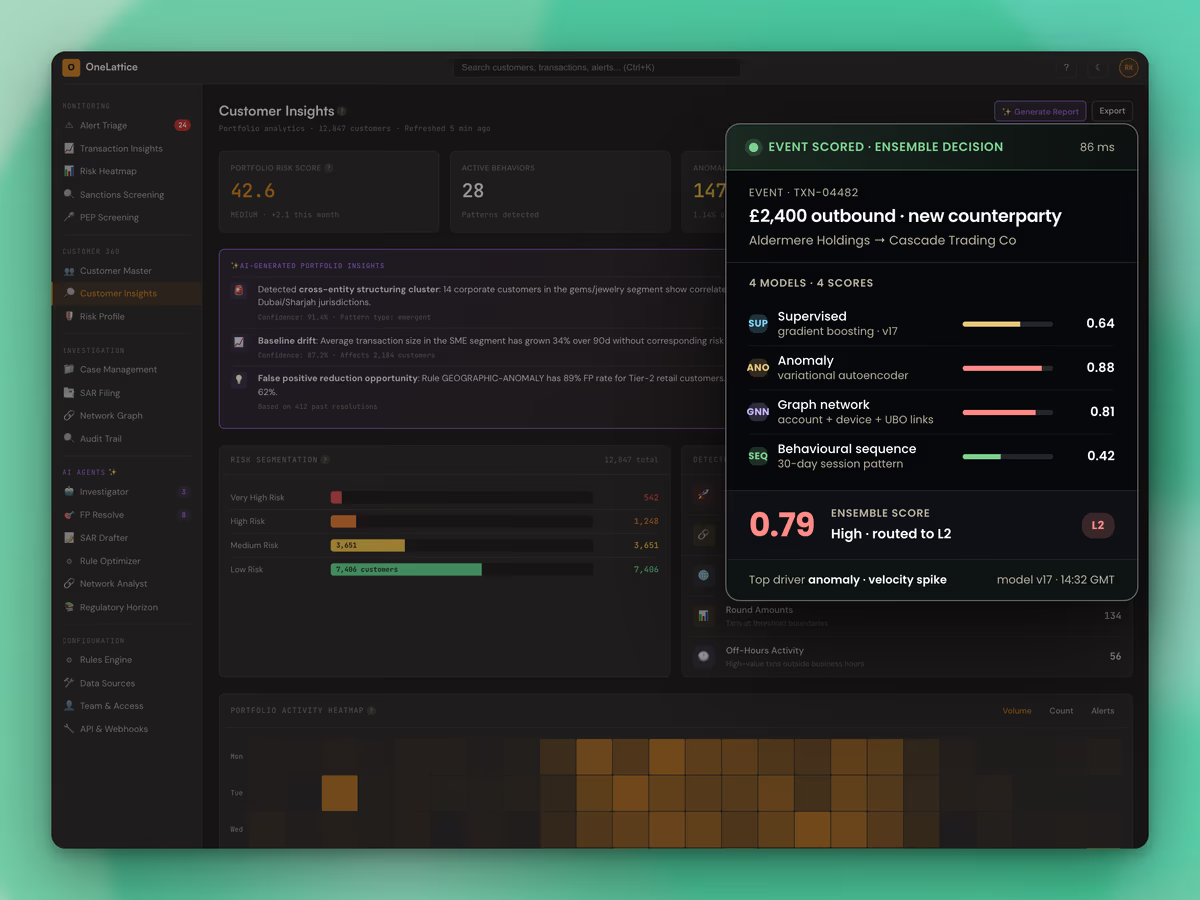
Layer four model families on every event.
Combine supervised, anomaly, graph, and sequence scores into one decision your reviewers can defend.
Supervised Scoring
Score every event against labeled fraud and AML outcomes using gradient boosting and deep learning.
Anomaly Detection
Catch novel typologies before labeled examples exist by learning what normal behavior looks like and flagging what deviates.
Graph Neural Networks
Surface mule networks, layering chains, and coordinated rings that pairwise rules miss.
Behavioral Sequences
Spot account takeover and AML risk from session, device, and counterparty sequences.
Ensemble Scoring
Combine every model into one score and show reviewers exactly how each one weighed in.
Feature Engineering
Compute fincrime features in real time, including structuring proximity, peer-group deviation, sanctions-adjacency hops, dormancy-burst, and counterparty topology.
FEATURE LIBRARY
Score every event against hundreds of fincrime features in real time.
Your models use the same feature library as ours.
Skip the cold start
Skip months of feature engineering. Your models train on day one.
Feed every feature into your own models
Pull the full feature library through the model API and ship your own models from training to production in days.
Move from training to production in days.
Train on your data with assisted model selection and hyperparameter search. Your model risk team reviews and overrides every choice.
Backtest against historical data. See precision, recall, and false-positive rates by fraud type, segment, and time period.
Score live traffic in parallel without affecting decisions. Compare a candidate model against the one in production, event for event.
Promote with maker-checker approval. Every deployment carries a version, an approval chain, and a one-click rollback if performance degrades.
Track model performance, feature distributions, and data drift in real time. Alerts fire when any metric crosses a threshold you set.
Explain every score. Audit every model.
Governance lives inside the lifecycle, from first training run to last production score.


Move your fincrime ML onto one stack.
Run the full ML stack in one platform
Run feature engineering, training, scoring, monitoring, and governance on one stack. Your team operates the full lifecycle without stitching point tools together.
Cover the typologies your rules can't express
Graph models catch mule rings, sequence models catch dormancy-burst patterns, anomaly models catch novel typologies before labeled data exists. Run them as an ensemble next to your rules.
Deploy your own models on the same infrastructure
Your data science team uses the same feature library, the same scoring pipeline, and the same monitoring. Platform models and custom models run side by side.
Explain every decision to an examiner
Pull score decomposition, feature contributions, version history, and training-data lineage from one trail. Your compliance team answers any model-risk question from it.
See what changes when production ML runs on OneLattice.
Power these solutions with the same models.
Every solution below runs supervised, anomaly, graph, and sequence models on the OneLattice stack.
Transaction Monitoring
Surface unusual AML patterns with ensemble and sequence models, then route alerts to investigators.
Learn more →Mule Detection
Surface mule rings and layering chains with graph neural networks that pairwise rules miss.
Learn more →Account Takeover Prevention
Spot account takeover from session, device, and behavioral sequence patterns.
Learn more →New Account Fraud Prevention
Catch synthetics, bots, and mules at signup with anomaly and supervised models.
Learn more →Identity Fraud Prevention
Score identity risk in real time with supervised and anomaly signals across the application.
Learn more →Customer Risk Assessment
Calibrate every customer risk score with supervised models trained on your data.
Learn more →