See the rings
one bank cannot see alone.
Build investigations on a fincrime knowledge graph spanning ownership, counterparties, sanctions, and trade, with tokenised fraud signal layered on top so every alert and EDD review opens onto the connected picture.
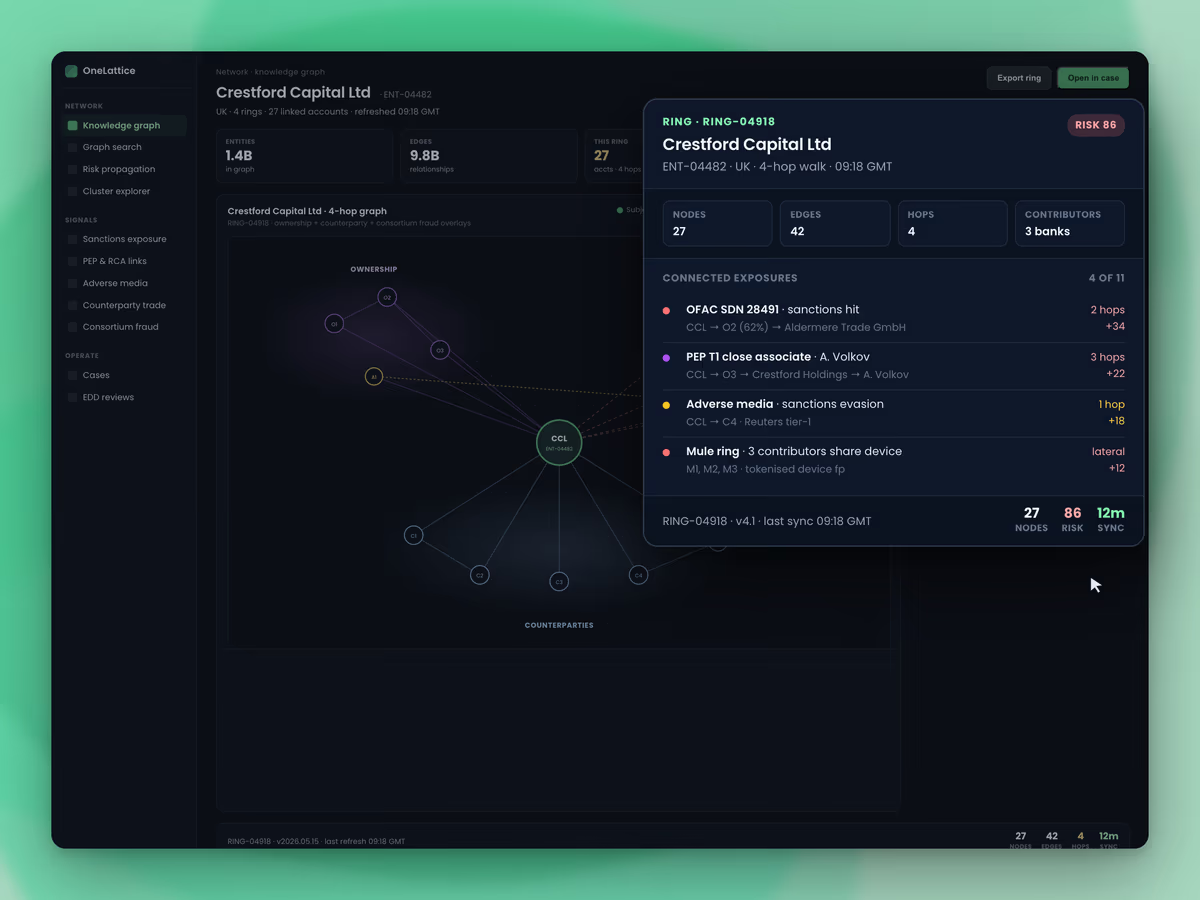
Build the fincrime knowledge graph as you run your program.
Search a knowledge graph spanning ownership, counterparties, sanctions, and trade.
Search billions of entities and relationships pulled from corporate registries, beneficial-ownership filings, sanctions and watchlist publications, court records, investigative leaks, and trade flows, all resolved into one graph.
Every node and edge carries the issuing source, publication date, and link back to the originating document.
See the data sources
Surface risk by association the moment a customer connects to a known signal.
Pre-built risk factors flag sanctions exposure, PEP and RCA links, adverse media, forced-labour risk, and ownership through high-risk jurisdictions on every entity in the graph, propagating across the network.
Configure depth, edge weights, and propagation rules per risk type so distant links carry proportionate signal.
See the risk factors
Open every alert, investigation, or EDD review onto the live knowledge graph.
Open any case onto the live graph already drawn around the customer. Trace ownership through nominee directors, intermediate holdcos, and indirect stakes; surface counterparty exposure across sanctions, adverse media, and trade flows.
Every traversal logs the path, the linking signal, and the source that drove it, so the investigation trail holds up to your second line and your examiner.
See the investigator view
Layer tokenised fraud signal on top of the knowledge graph.
Hashed device, identity, and account fingerprints from contributing institutions surface mule rings, scam networks, and synthetic-ID clusters that public records alone cannot show.
Customer data never leaves your environment; only deterministic and probabilistic links join the same entity across contributors.
See the contributor model
Run fraud and AML on the same graph.
The same graph that catches a mule ring catches the laundering network it feeds. Fraud and AML teams work the same connected picture.
See network detection in action→Mule rings
A reused device, phone, or email links the application to confirmed mules at three other contributors before the account funds.
Scam victim and perpetrator networks
The beneficiary lights up the instant your customer initiates the transfer, before the funds leave.
Account takeover clusters
A flagged device surfaces the coordinated session pattern across linked accounts and scores on first contact.
Synthetic identity rings
Fragments reused from confirmed rings stack signal at onboarding instead of after a 90-day bust-out.
Money laundering networks
The pass-through account expands into the mapped laundering chain inside the case view.
Sanctions evasion graphs
The layered counterparty chain resolves on the entity graph alongside the watchlist hits.
First-party fraud rings
The linked applicant cluster surfaces before the next account in the ring funds.
WHAT FLOWS INTO THE NETWORK
Walk every layer of fincrime intelligence on one graph.
Every layer resolves onto the same entity so ownership, sanctions, adverse media, relatives, trade flows, and contributor fraud signal share the same node.
Ownership
Walk every layer of the ownership structure across registries, nominees, and indirect holdings until every natural person is named.
Sanctions and watchlists
Trace direct hits and inherited exposure across subsidiaries, controlled entities, and successor companies on the same graph.
Adverse media
Tie every adverse media match to the resolved entity with the article, allegation category, and source attached.
Trade and counterparty flows
Map cross-border shipments to consignors, consignees, and beneficial owners on the entity profile.
Contributor fraud signal
Layer tokenised device, identity, and account fingerprints onto the same entity to surface rings that public records alone cannot show.
Relatives and close associates
Map RCAs, family members, and known associates of every PEP and high-risk entity onto the same graph for full network exposure.
See network signal where your team already works.
See it in the platformAn applicant linked to a sanctions chain, adverse media cluster, or fraud ring on the knowledge graph stacks signal on the first decision, before any history at your shop.
A counterparty mapped to a sanctions-evasion path on the network surfaces in the screening result alongside the watchlist hits.
A payment to a beneficiary already flagged on the graph fires the alert with the full connected cluster attached.
Open every investigation onto the knowledge graph already drawn, with accounts, devices, counterparties, and typology labels tying the ring together for the investigator.
The closure label and typology feed back into the knowledge graph the moment the case is filed, so the next investigation opens onto the strengthened ring.
Pull every connected entity, beneficial owner, and counterparty straight from the knowledge graph the moment an EDD case opens, with the typology and ring context already attached.
Power these solutions with the network layer.
Every solution below runs on the same contributor graph so rings, mules, and shared-asset clusters surface on the same record as the entity itself.
Mule Detection
Walk the graph to surface mule rings, layering chains, and shared-account patterns that pairwise checks miss.
Learn more →New Account Fraud Prevention
Catch synthetic identity rings and bot waves at signup through device, identifier, and behavioral linkage.
Learn more →Payment Fraud Prevention
Score every authorization against the counterparty network so coordinated payouts surface before money moves.
Learn more →Identity Fraud Prevention
Surface manufactured identities clustered by shared device, address, and document signals.
Learn more →Account Takeover Prevention
Spot coordinated takeovers through shared device fingerprints, behavioral biometrics, and credential reuse across accounts.
Learn more →Transaction Monitoring
Score transactions against the counterparty network so ring-level typologies fire on the same alert as the customer.
Learn more →Sanctions Screening
Inherit sanctions exposure through subsidiaries, controlled entities, and successor companies on the same record.
Learn more →Investigation & Reporting
Hand investigators one connected case file with every linked party, account, and signal pre-loaded.
Learn more →