Run one resolved entity
across every system in your stack.
Pull customers, counterparties, and UBOs into one record so investigators work one entity per real-world party and reviewers see fewer duplicate alerts.
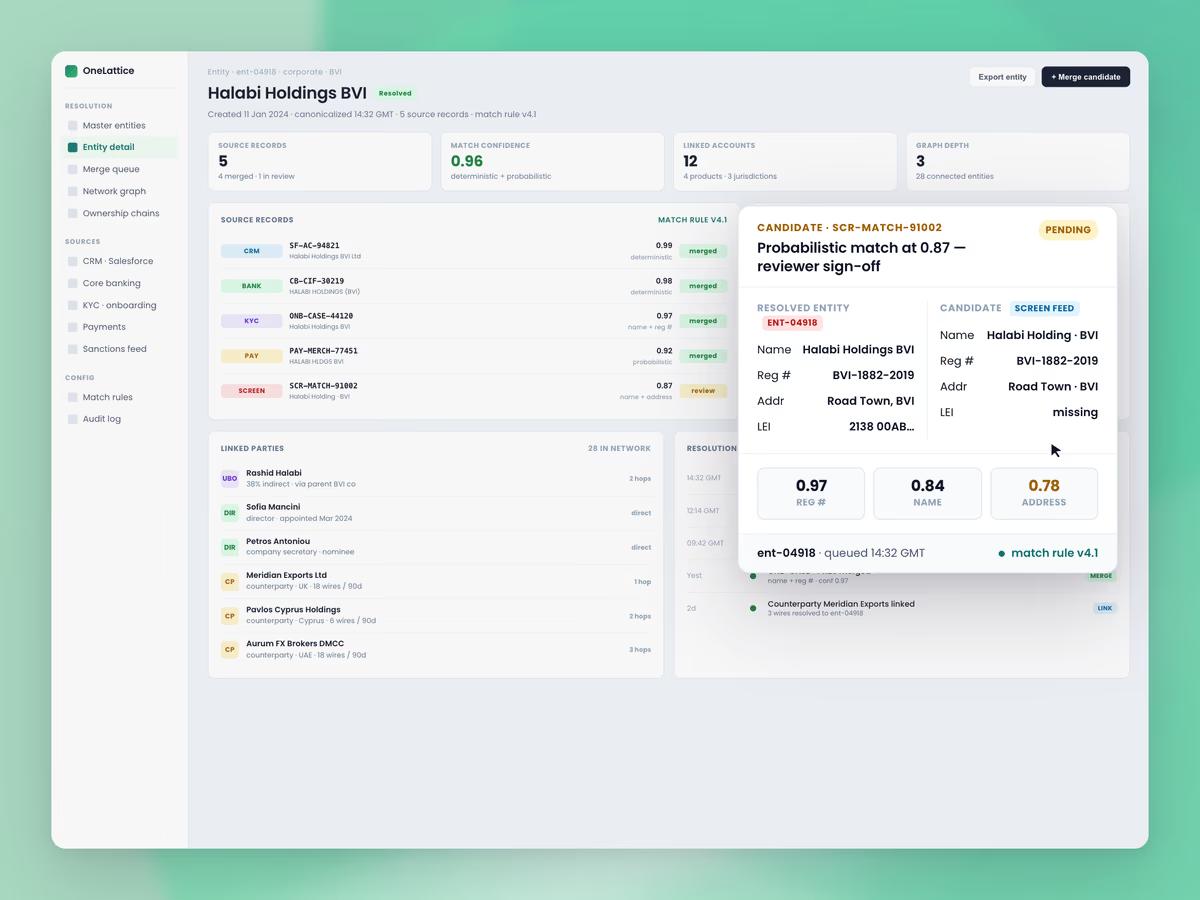
How the resolution engine works
Resolve records across internal silos into one profile.
Merge core banking, CRM, onboarding, and payments into one entity using deterministic keys, probabilistic name and address matching, phonetic and transliteration handling for non-Latin scripts, and n-gram blocking for recall on common names.
Every merge carries a confidence score and the signals that drove it.

Resolve records across internal silos into one profile.
Merge core banking, CRM, onboarding, and payments into one entity using deterministic keys, probabilistic name and address matching, phonetic and transliteration handling for non-Latin scripts, and n-gram blocking for recall on common names.
Every merge carries a confidence score and the signals that drove it.
Move your compliance team onto one resolved entity.
Match screening hits to one entity
Pull every screening hit onto the one resolved party, with sanctions, PEP and RCA flags, adverse media, and registry data already attached.
Defend every merge in an exam
Log every merge with its confidence score, matching signals, threshold and rule version, and analyst override so your team can reproduce the decision at the date and version it was made.
Re-resolve and re-screen on every change
Trigger incremental re-resolution and re-screening on every transaction, KYC refresh, registry update, and list delta so a sanctioned UBO never sits unflagged waiting for a nightly batch.
Tune thresholds without a vendor ticket
Own blocking keys, match weights, score cutoffs, and auto-merge bands so your team can lower thresholds for common names, raise them for high-risk geographies, and deploy changes in hours with full audit.
Move your compliance program onto one resolved entity.
Power these solutions with one resolved entity.
Every solution below runs on the same resolved entity so screening, monitoring, and investigation see one connected case per real-world party.
Sanctions Screening
Screen the resolved entity once instead of every name spelling and ID variant separately.
Learn more →PEP Screening
Match every customer and counterparty to the right political exposure and relationship-network record.
Learn more →Adverse Media
Tie every adverse media match to the resolved entity instead of the surface-level name string.
Learn more →Mule Detection
Walk the relationship graph to surface mule rings, layering chains, and shared-asset clusters.
Learn more →Perpetual KYC
Re-resolve the customer on every signal and trigger a review when the entity shape changes.
Learn more →Customer Risk Assessment
Score the resolved entity once across every product, channel, and jurisdiction it touches.
Learn more →Customer Onboarding
Resolve every applicant against existing records before opening the account so duplicates and adverse exposure surface upfront.
Learn more →Investigation & Reporting
Hand investigators one resolved case file with every alert, transaction, and signal attached.
Learn more →Pair entity resolution with the rest of the stack.
Run resolution as one layer of a connected fincrime platform.
Data
Ingest customer, transaction, and registry data into the same pipeline that feeds resolution.
Network
Take resolved entities into a network view that surfaces rings, mules, and shared-asset clusters.
Single Customer View
Render the resolved entity as one screen for every analyst, reviewer, and investigator.
Scenarios Engine
Author detection scenarios that fire on the resolved entity across every product and channel it touches.