Stop fraud at signup before the account ever opens.
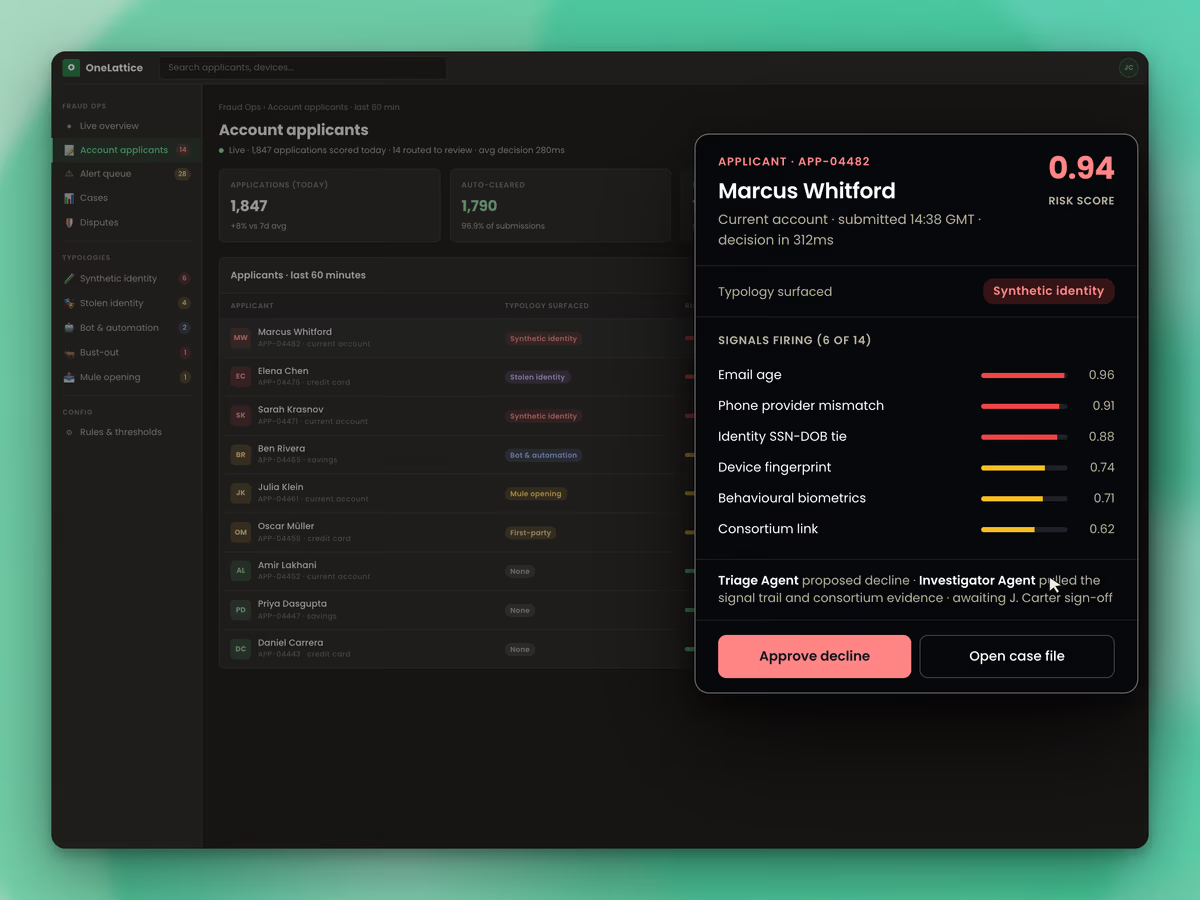
Score every applicant on the signals the system already sees, and name the fraud typology behind every decision so an investigator picks up the case in context.
Catch synthetics and stolen identities
Block bots at signup
Surface mules and first-party intent
Tune friction to the signal
FRAUD TYPES COVERED
Cover every typology at account opening.
Each card names the pattern the applicant walks in with, and the decision carries the typology, the signals, and the case file straight to the queue.
Synthetic Identity
Catch the applicant whose email is too new, phone is too fresh, and identity fields don't tie back to a real person.
Stolen Identity
Catch the impostor who submits real identity data from breach records but whose device, behaviour, and consortium history contradict the claim.
Bot and Automation
Catch the emulator, headless browser, or CAPTCHA farm before submit, on the device, timing, and injection signals the session leaks.
First-Party Fraud
Catch the genuine applicant whose velocity, multi-accounting, and consortium links signal intent to default before the line ever funds.
Mule Account Opening
Catch the mule applicant opening a fresh account to receive third-party funds, on device linkage and account-farm patterns that surface the ring before any money lands.
Bust-Out Fraud
Catch the bust-out before the default lands, on footprint-continuity gaps and linked-account patterns the patient profile leaves behind.
HOW IT WORKS
Trace every decision from signal capture to disposition.
Stream device fingerprint, behavioural biometrics, session telemetry, email, phone, and IP into the file from the first form keystroke, so emulators, injection tooling, and remote-access tools surface before the application closes.
Run the name, address, phone, and email against breach databases, digital footprint sources, and consortium identity data, and attach phone tenure, porting history, email age, and prior fraud associations to the applicant file.
Link the applicant to every device, phone, email, and address across the customer base and the consortium, so a shared device, a linked phone, or an account-farm pattern surfaces before approval runs.
Return a risk score, a fraud typology, and the weighted signal contributions on every decision, so an investigator picks up the file already knowing what they are looking at.
Clear the low-risk applicants in one pass, send the elevated to the step-up the signals call for, and route the high-risk to decline or review with the typology and signal trail attached.

PROGRESSIVE DECISIONING
Calibrate friction to risk and document every decision.

Clear low-risk applicants automatically
Clear the applicant whose device, footprint, and network all read clean, without asking for a document, an OTP, or a liveness check, and let the reason codes sit on the case.
Step up only the applicants the signals call out
Apply the OTP, the ID reverification, or the liveness check only when the matching signal fires, so the applicant gets the friction the file actually needs and nothing more.
Decline high-risk and route the case to review
Route the high-risk applicant to decline or review with the typology, the signal trail, and the network evidence already on the case, so the investigator opens the file with the work half done.
Defend every decision to your examiner.
Carry the signal trail, the typology, the model rationale, and the change history on every decision, so an examiner reads the full story off the record without anyone reconstructing it.
OUTCOMES
Catch more fraud at signup without rejecting more real customers.
Raise the catch rate at signup
Surface the synthetic, the mule, and the first-party case that score-only tools miss, by reading the signals together before the account ever opens.
Book a Demo→Approve more real applicants
Apply friction only where the signals demand it, so legitimate applicants clear under your identity-verification policy and the rationale sits on the case.
Book a Demo→Open the case ready to file
Hand the investigator a case with the typology, the signals, the network evidence, and a SAR-ready narrative draft, so the team skips triage and moves straight to filing.
Book a Demo→COVERAGE
Check coverage for the exact threat you face.
Read every fraud type and attack vector against the signals the model already collects at the account opening moment.
Fraud Types Detected
- Synthetic identity
- Stolen identity
- First-party fraud
- Mule account opening
- Bust-out fraud
- Promo and bonus abuse
Attack Vectors Caught
- Emulators and VMs
- Bot and CAPTCHA farms
- Device and fingerprint spoofing
- Document forgery
- Deepfake and GenAI identity documents
- Proxy, VPN, and Tor
- SIM-swap and phone porting
Signal Inputs Used
- Device fingerprint
- Behavioral biometrics
- Email age and breach data
- Phone age and port history
- IP and network signals
- Entity link graph
- Velocity and multi-accounting
- Sanctions and PEP screening at application
- Adverse-media screening
Agents on this workflow.
OneLattice's purpose-built agents that handle this work end-to-end.
Triage Agent
Works the signup queue end to end and learns from every analyst disposition.
Investigator Agent
Builds the new-account case before the investigator opens it and recommends the next action.
Network Analyst
Maps account-farm rings on the cross-customer graph and surfaces the next one fast.
Pattern Analyst
Catches novel signup fraud patterns hiding in your data before any rule library does.
PLATFORM
Take the same stack across the rest of the fraud and compliance work.
One platform from signup through investigation.
Identity Fraud Prevention
Catch synthetic IDs and forged documents on the same signal stack.
Learn more →Customer Risk Assessment
Tier every applicant at intake and route the path from one number.
Learn more →